
See the Mitchell County Owner-of-Record Card
The county's stated hub for routine parcel research is the official Mitchell County Parcel Search. It is the logical first stop. A result card typically pairs the parcel number with the owner name, the mailing address, the site address, appraisal figures, and tax details. Exact fields vary from parcel to parcel.
| Owner of Record | The person or entity carried for assessment |
|---|---|
| Mailing Address | Where county notices go, when shown |
| Situs Address | The physical location of the parcel |
| Parcel or Tax ID | The key used across county systems |
| Deed Reference | A lead to the recorded instrument, when displayed |
| Last Sale | A dated transaction clue, not final title proof |
Owner and occupant can differ. A tax-mailing address is a contact route, not proof of residence, and the situs describes the land rather than the person. Use the official Mitchell County Parcel Search.
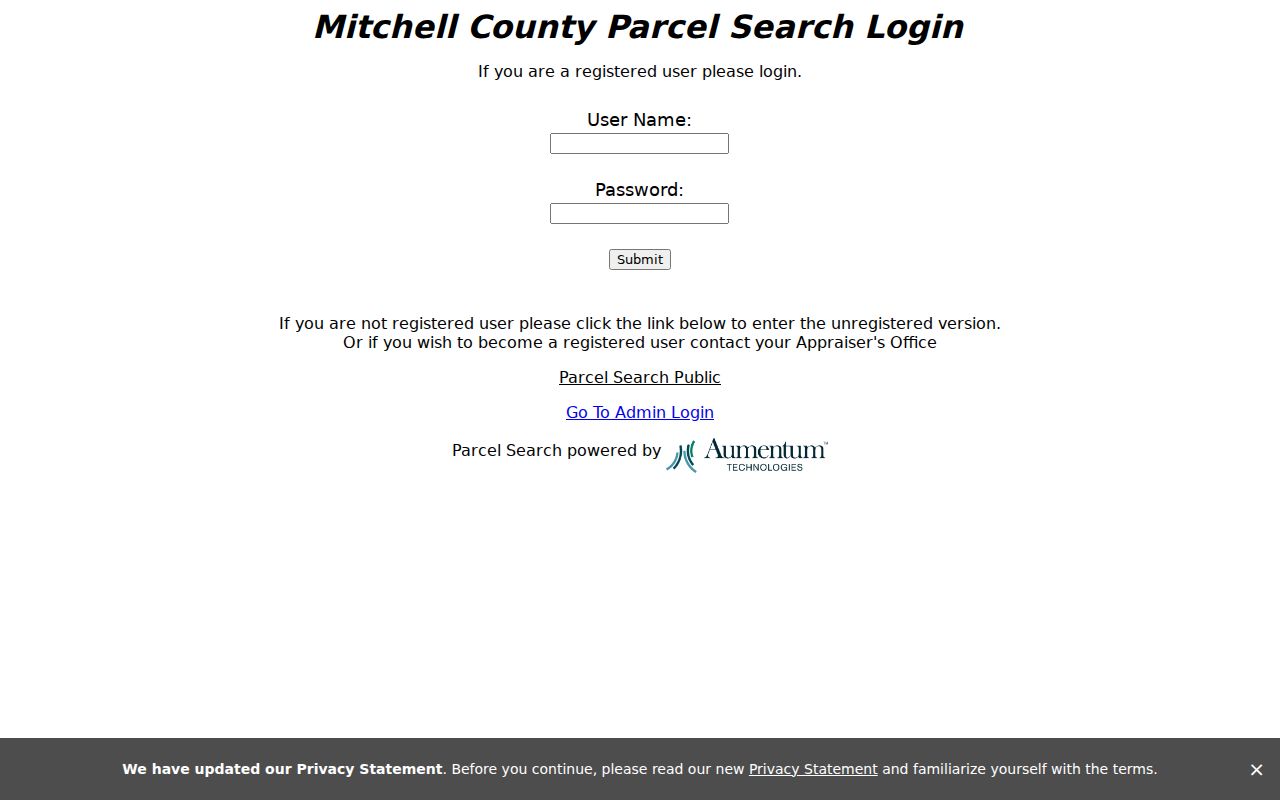
The screenshot shows the county's official parcel-search entry point. Each field on a live parcel card still has to be read and confirmed individually.
Confirm the Current Mitchell County Owner
Move from the working roll to the controlling record. The Register of Deeds records deeds and the other instruments that affect Mitchell County real estate. The county site offers no public searchable deed index.
- Find the parcel in the Mitchell County Parcel Search and retain the exact name and parcel key.
- Contact the Register of Deeds with that key and legal description for the latest deed reference.
- Compare the grantee, deed date, and recording date with the roll entry.
- If an entity is named, check its exact name in the Kansas business search.
- Owner of record
- The party carried on a dated public ownership record.
- Recording lag
- The interval between a transfer and an updated roll label.
- Registered agent
- A contact for an entity, not necessarily the land's beneficial owner.
Reach a Mitchell County Property Owner Lawfully
A mailing address on the tax roll supports a legitimate purchase, fence, access, or estate inquiry. It is not proof of residence. Kansas Safe at Home provides substitute-address protection for qualifying victims of abuse under K.S.A. 75-451 through 75-458. Contact through that program respects the shield.
Lawful use. Use current-owner information only for a legitimate property purpose. Never use a public record to stalk, harass, intimidate, or harm anyone.
Date the Mitchell County Current Owner Finding
Mitchell County's appraisal calendar uses January 1 as the valuation date. Value notices follow by March 1, and values are certified by June 1. Those dates frame the assessment roll's yearly cycle. But the county sets no fixed local update interval after a sale closes. Note: record the portal access date, since a displayed owner may not be current to the day.
A deed date also differs from its recording date. County rules move instruments received after 3:30 p.m. on the last business day of January through November to the next business day. A 10:00 a.m. cutoff applies in December. This explains many one-day discrepancies.
Verify Mitchell County Entity Owners
An LLC or corporation on the tax roll calls for one more step. The Kansas Business Entity Search accepts a business name, a Kansas business ID, or a resident-agent name. A resident agent is a lead, not an owner. Trust and estate names may require the deed, an affidavit, the probate file, or a public court order. Kansas CaseSearch offers basic statewide district-court case details. Always match court leads to the parcel's legal description.
Ask Mitchell County for Records, Not Conclusions
The Register of Deeds sits at 111 S Hersey in Beloit, open 8:30 a.m. to 5:00 p.m. weekdays, with phone at 785-738-3854 and mail at PO Box 6. Requests work best with the parcel number. Add the exact owner spelling, an approximate date, and the legal description. Staff can locate and provide a record. They are not trained for title searches, though. Competing deeds, easements, or questions of legal effect call for qualified title or legal help.
Keep the Mitchell County Owner Check in Scope
The current-owner question asks who the roll and newest deed name today. It skips the older chain. Unrecorded claims also stay outside its reach. The Mitchell County former-owner guide handles the backward chain of title. This inquiry stays in the present tense. KORA allows inspection and copies, subject to exceptions, procedures, and reasonable fees. K.S.A. 45-230 also restricts certain uses of lists of names drawn from public records. Keep only the details the property question needs. Never publish personal data just because it is visible. Note: Preserve the parcel number and legal description, because names and street labels change while those land keys stay stable.
Check Releases and Orders Behind a Mitchell County Owner
The newest deed is not always the only instrument that matters. The Register also records mortgages, releases, liens, and affidavits. A release clears an encumbrance rather than naming a new owner. An affidavit is not a sale deed. These records explain why a name appears with another party or why the owner line alone cannot settle a property question. Public court material adds context for probate distributions, partitions, and quiet-title matters. Mitchell County sits in the 12th Judicial District. Its court is at 115 S Hersey in Beloit. Internet CaseSearch offers basic public case information, and courthouse terminals can reach records not posted online. Keep the case number and recording reference together.
Handle a Mitchell County Portal Gap
A dead web page does not hide the owner of record. It just moves the work offline. Keep the street address and any tax ID you already have. Then call the Appraiser for the current tax roll entry. Call the Register of Deeds for the newest recorded instrument. The County Clerk handles change-of-ownership paperwork for tax purposes. The Register, though, stays the official real-estate recording office for Mitchell County.
Anyone can file a KORA request. An agency may insist on written form and advance payment for copies. It must explain any delay or denial in writing. Build the request around a parcel number, legal description, owner spelling, and a date range. That level of detail lets the custodian respond without drafting a title opinion for you.
Preserve the Mitchell County Source Date
A current-owner claim means little without a date attached. Save a copy of the parcel result. Note the day you checked it. Record the tax year shown. Cite the newest deed by its actual book, page, or instrument number from the Register. The two sources may disagree. Report both dated findings and the likely update gap. Do not quietly pick one.
Dating everything makes a later recheck easy. Return to the same parcel number. Ask the Register whether a newer instrument has been recorded. Check whether the tax roll has caught up. That beats calling an owner "current" with no record date. It matters especially near a closing, a year-end recording cutoff, or the January 1 appraisal date.
Mitchell County's recording cutoff adds a wrinkle. Documents delivered after 3:30 p.m. on the last business day of January through November record the next business day. December uses a 10:00 a.m. cutoff. It records on the first business day of January. A deed's signing date also differs from its recording date. Keep both dates beside the tax-year snapshot whenever a transaction lands near month end or year end.
The parcel portal may not load. Write down the failed attempt. Use the office route instead. The Appraiser can supply the dated roll entry. The Register can supply the newest instrument tied to the same legal description. The result is two clearly labeled records rather than one unsupported claim about the owner of record.
Note: Preserve the exact owner label, including trust or entity wording, so any later deed comparison stays reproducible.