
Fields in Mitchell County Property Tax Records
The Mitchell County Appraiser discovers, lists, and appraises every property. The Treasurer collects the revenue. Taxable and exempt parcels alike, along with real-estate, personal-property, and special-assessment money, keep the two offices meeting at the same parcel and year while answering different questions.
| Field | What It Shows | Where |
|---|---|---|
| Appraised value | County estimate before the class ratio | Appraiser parcel record |
| Assessed value | Taxable value after the Kansas class rate | Appraiser roll and statement |
| Tax ID and year | Account and billing period | Tax Search |
| Levy or tax units | Local jurisdictions applied | Statement and Clerk records |
| Amount and status | Bill, installments, and payment | Treasurer |
The assessor never collects the bill. The Treasurer never sets the appraisal. Send any question about a property characteristic or a value correction to the Appraiser, and take payment or delinquency questions straight to the Treasurer.
Tax Search Displays 1989 Through 2025
The official Mitchell County Tax Search offers a year selector running from 1989 through 2025. That span reaches deep enough for historical comparison of a parcel's tax bill or tax roll entry. Keep one caution in mind, though. A wide range does not guarantee every account carries a result. Coverage can be thin in some years.
| Search field | Input | Use |
|---|---|---|
| Last/company name | Owner or company text | Find a billed name |
| Tax ID | County identifier | Open a known account |
| Tax year | 1989–2025 displayed | Choose the billing period |
| Address number | Numeric component | Narrow the situs |
| Prefix, direction, street | Separate address parts | Match portal structure |
| ZIP | Postal code | Distinguish similar streets |
The tax search covers billing years 1989 through 2025, so both current and older tax bills can be pulled by parcel or name. Value details, exemptions, and payment status appear on the live result card.
The Parcel Portal Supplies Value Context
The county posts its Mitchell County Parcel Search on the Appraiser, Clerk, and Treasurer pages. Start there. It is the right place for parcel details, appraisal figures, and ownership context drawn from the county's own records, and it pairs well with the tax roll the Treasurer maintains. Expect occasional slow loads. The portal does not always respond quickly, so patience helps.
If it will not open, call Appraiser Melinda K. Latham at 785-738-5061. The office sits at 111 S Hersey, PO Box 5, Beloit. Ask for the parcel record or the valuation notice tied to a specific tax ID and year, and request the source date so you know how current the figures are. The official parcel-search screen displays the county's own data fields.
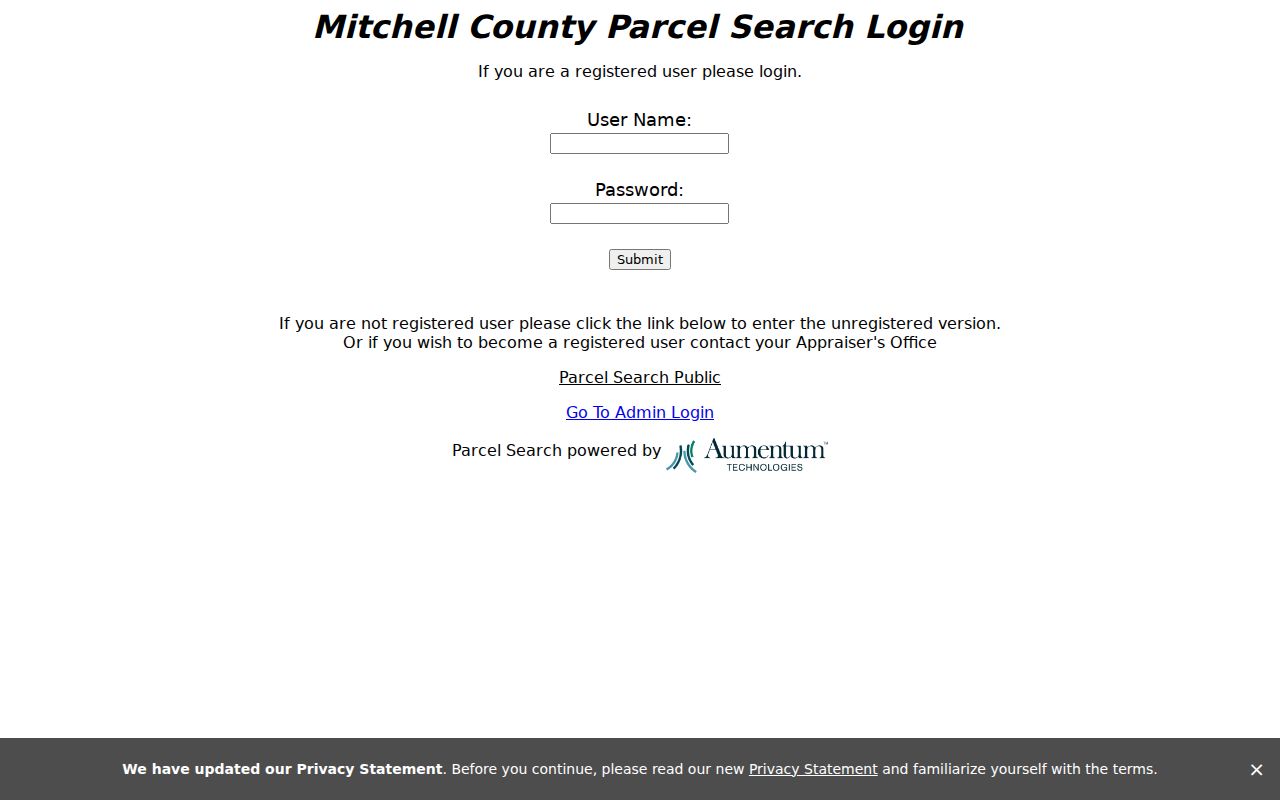
The official entry page remains the access point for parcel research in Mitchell County. When the live result does not appear, the Appraiser's counter and phone line keep the workflow moving without losing anything.
Note: A tax year, deed recording year, and sale date can differ for the same transfer.
Look Up a Mitchell County Tax Bill
Begin with the strongest identifier and verify the account before interpreting the amount.
- Enter the tax ID or assemble the address from number, direction, street, and ZIP fields.
- Select the relevant tax year rather than assuming the newest year is the one needed.
- Confirm the account against the situs and legal-description context from parcel records.
- Read bill and payment status, then ask the Treasurer about unclear postings or delinquency.
- Assessed value
- The taxable value after the Kansas class rate.
- Levy
- The combined local taxing-unit rate applied to assessed value.
- Exemption
- A statutory removal or reduction from taxation when eligibility is established.
- Tax lien
- A claim arising from unpaid taxes; a balance alone is not a sale notice.
Read the Mitchell County Tax Calendar
The county tax calendar sets the rhythm for the whole year. January 1 brings the valuation date. March 1 brings value notices, and the roll is certified June 1. Bills mail November 1 through 15. The first half or full payment is due December 20. Pay the first half on time. The second half comes due May 10 of the next year.
These dates explain why a balance shifts through the cycle. They also explain a common mismatch. A newly recorded deed may not yet match the name printed on a current statement.
The state publishes its own Kansas property-tax calendar with matching deadlines.
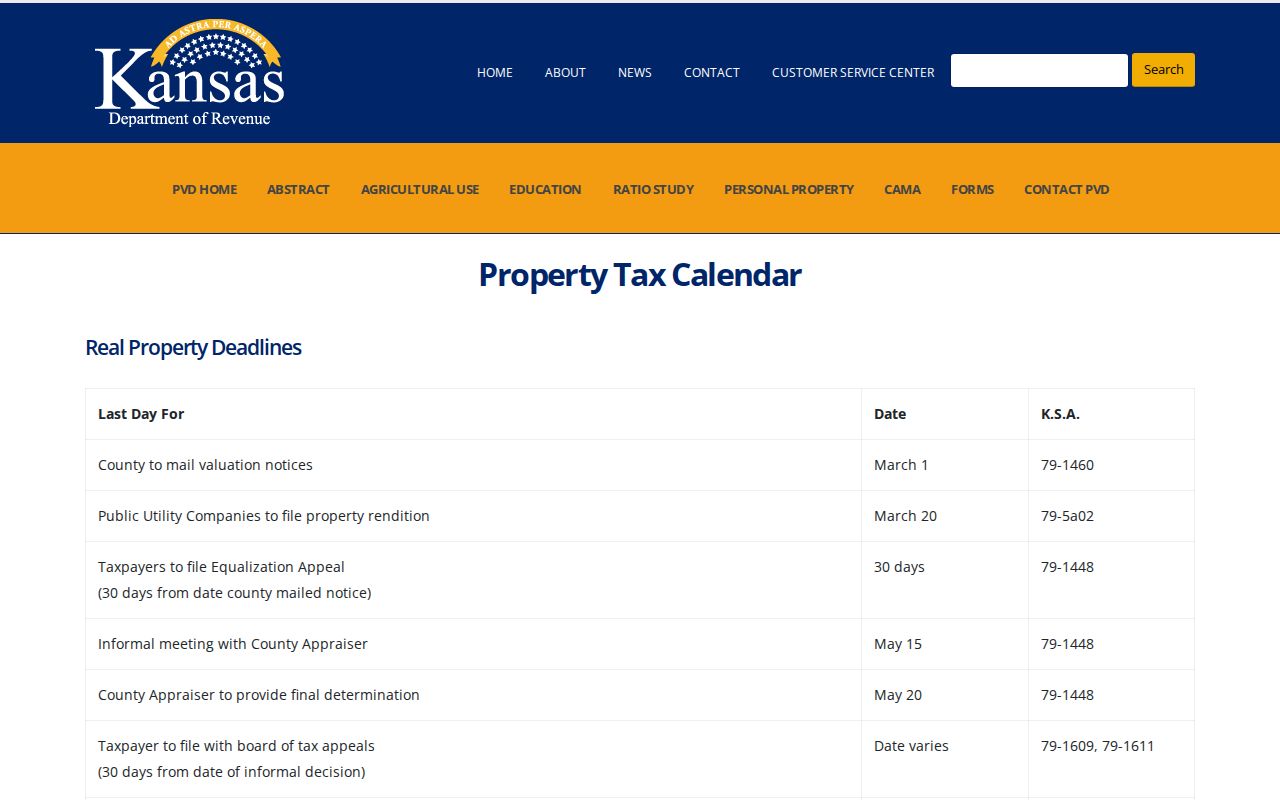
The state tax calendar sets the broad procedural landmarks for Mitchell County property owners. For the deadline that governs a specific appeal, though, the parcel's own notice remains the controlling source.
Assessed Value Is Not a Sale Price
Kansas does not tax property at its full appraised value. Instead, the state multiplies appraised value by a statutory class rate. Published rates include 11.5% for residential property. Commercial and industrial property is taxed at 25%, and vacant lots at 12%. Agricultural land pays 30% of economic-use value. Farmland is taxed on that economic-use figure. It is not taxed on a share of an ordinary market sale. Local levies then shape the final bill.
Sale price, appraised value, assessed value, and tax due are four different numbers. The Mitchell County property value page compares them side by side.
The 2026 Market Study Is Countywide
The Appraiser's 2026 market study reports stable residential and commercial indicators. The trend is generally upward. Vacant-property indicators were stable too, without any general climb or slide. That countywide finding is administrative context, not a forecast for a single parcel.
One property can still move against the trend. Characteristics may have been corrected. The property itself may have changed. Market evidence for it may have differed. A lake tract, a farm, a city lot, and a commercial site should not be expected to follow one identical path. Each moves through the tax roll on its own footing.
Note: Use the market study for context and parcel evidence for an individual valuation challenge.
Payment Charges Are Not Property Tax
The Mitchell County Treasurer handles every property tax payment in the county. Treasurer Michelle Langham's office is at 111 S Hersey, PO Box 425, Beloit. It is open weekdays from 8:30 a.m. to 4:30 p.m. Call 785-738-3411 with questions about a tax bill or the current tax roll.
Payment methods matter. County guidance says credit-card payments through Kansas.gov carry a 2.5% convenience fee. ACH or e-check costs $2 per parcel. Those charges go to the payment processor. They are not part of your property tax. Have the statement and payment method ready. Confirm the parcel number and tax year. Keep the receipt.
Delinquency Does Not Prove a Sale
County commissioners' 2025 minutes lay out a process in which a property must be delinquent for at least three years before it can be sold. That timeline is procedural, nothing more. It is not an auction schedule. It is not a parcel list, and it does not mean redemption has ended. Anyone tracing a specific Mitchell County parcel should get current delinquency history, notice records, sale details, redemption status, and any resulting deed from the offices that keep them. An old balance alone never proves who the owner of record is now.
Tax Units Explain Different Bills
The County Clerk fixes tax levies, prepares state tax abstracts, and prints tax statements. The parcel number tells only part of the story. Mitchell County maintains separate tax-unit, township, school, fire, and city maps. That is why two nearby parcels can answer to different combinations of jurisdictions. A postal city on an address cannot settle the question. Match the statement against the county tax-unit map. Check the Clerk's levy material too before drawing conclusions.
Location details matter here. Keep the township, range, and section for a rural tract. Keep the addition, lot, and block for a city lot. Those identifiers guard against comparing the wrong parcel. Street labels can look deceptively similar across the tax roll.
Watch also for special assessments. They can sit apart from the ordinary ad valorem tax on the same tax bill. Ask the Treasurer which line is the regular levy. Ask which is a special assessment. Ask how a payment was allocated. That keeps a billing question from turning into an appraisal dispute.
Document a Property Tax Search
Good documentation turns a property tax search into evidence you can rely on later. Save the official URL and the date you accessed it. Note the tax year, the tax ID, and the exact field labels shown on screen. Download a PDF or printout if the portal allows it. It also matters where the number came from. An appraisal notice, tax statement, portal result, and payment receipt each mean something different. A figure stripped of its year and source invites misreading.
When the online record is unclear or unreachable, go to the maintained record instead. Request it at the counter, by phone, or in writing. The Kansas Open Records Act lets an agency require a written request plus advance payment. Exceptions can apply. Ask for a specific parcel and year rather than a broad collection.
Contest a Mitchell County Assessment
Kansas guidance generally gives owners 30 days from the March value notice to file an equalization appeal. The informal meetings land around May 15. A final determination follows near May 20. The roll is then certified on June 1. Always verify the deadline printed on your own notice for that tax year.
Build the case before you file. Gather the parcel record, the notice, photographs or measurements showing wrong characteristics, and market evidence that fits. Kansas guidance also warns that equalization and payment-under-protest cannot both be used for the same property and year.
Appeal window. Use the deadline on the Mitchell County notice; the general Kansas equalization period is 30 days after mailing.
Keep the valuation dispute separate from the tax payment itself. The Appraiser maintains the property characteristics, classification, and value record. The Treasurer handles the bill, payment status, and collection. A focused inquiry names the parcel, the tax year, the notice date, and the disputed field. It also names the evidence behind the correction. Building size disputes call for measurements or photographs. Classification disputes call for the actual use. For value, compare evidence from the same period and property type.
The county's 2026 market-study notice offers context, not a parcel result. It described residential and commercial indicators as stable with a general upward trend. Vacant-property indicators were stable without any general trend. Individual Mitchell County values can still move for several reasons. These include corrected characteristics, physical changes, or market evidence. Quote the parcel notice rather than treating that countywide statement as a percentage.
Older bills have limits online. The visible selector runs from 1989 through 2025. A listed year does not guarantee a complete record for every account. When a year or status is missing, ask the Treasurer about counter or written access. County commissioners discussed a three-year delinquency threshold in 2025. Those minutes are not a current sale list. A genuine sale claim needs the actual notice, schedule, redemption facts, and the resulting deed.
Preserve the bill date, tax year, and payment receipt with any conclusion. Note: Ask the Treasurer to confirm any status missing from the online record.