
Build a Mitchell County Former-Owner Timeline
Open with the current parcel and its newest deed, then log one row per transfer. Mitchell County publishes no online deed index. The Register of Deeds counter becomes the working source. A focused written request does the same job from a distance. That office and its records anchor the whole chain.
| Source | Years It Covers | Where Held | What It Shows |
|---|---|---|---|
| Recorded deeds | Exact online cutoff not verified | Register of Deeds | Grantor, grantee, date, legal description |
| County microfilm | Holdings vary by volume | Kansas Historical Society and courthouse | Earlier deed and index images |
| Plat atlases | 1884, 1902, 1917, 1978 | Kansas Historical Society | Owner and place snapshots |
| Newspaper microfilm | As early as 1871, not complete | Port Library | Sale, estate, and legal-notice context |
Only the deed proves a transfer. Atlases and newspapers supply useful clues, bridging an era or clarifying a spelling. They never replace the instrument itself.
Walk the Mitchell County Deed Chain Backward
A clean chain shows each prior owner twice. The owner appears first as the grantor who sold, then earlier as the grantee who bought. The legal description ties both entries to one parcel. That thread is the proof.
- Find the newest deed and read its grantee, grantor, date, and full legal description.
- Search the grantor as an earlier grantee and match the same land description.
- Repeat the transfer in reverse, keeping book, page, or instrument references.
- When digital access ends, continue in the reverse index and deed books or microfilm.
- Grantor / grantee
- The transferring party and receiving party.
- Chain of title
- The ordered series of instruments affecting the same land.
- Reverse index
- An index organized to help trace a named party backward.
- Warranty / quitclaim
- Different deed forms whose legal effect should not be inferred from the label alone.
Measure Mitchell County Ownership Time Depth
Mitchell County was established in 1867 and organized in 1871. Yet neither date guarantees a first surviving deed. The county publishes no online-index cutoff or recorder imaging date. No catastrophic courthouse loss is on record. State that gap plainly. Ask the Register and the Kansas Historical Society which volumes cover the period you need.
Coverage limit. No earliest online deed year was verified for Mitchell County. Older former owners may require deed books, microfilm, and archive research.
Use Mitchell County Atlas Snapshots as Clues
The Kansas Historical Society finding aid lists Mitchell County ownership-map and plat-book material. The holdings span 1884, 1902, 1917, and 1978. Each snapshot can place a surname, farm, road, or town addition in an era. Street addresses were a poor key in that period. An atlas label is not a deed transfer, though.
The digitized Standard Atlas adds township and city plats plus patron and business directories. Treat it as a pointer. Use an atlas entry to settle the right township, range, section, lot, or party spelling. Then return to the county deed sequence for the instrument itself.
Follow Beloit's 1872 Plat into Earlier Owners
Beloit's official history records the filing of its townsite plat with the Register of Deeds on March 26, 1872. That date anchors the shift from a modern street parcel to the original lot-and-block scheme. Set the plat beside the 1884 atlas. The comparison can show how early town geometry persisted.
Later deeds often name an addition instead of a street address. Record every addition, block, lot, township, range, and section term exactly as written. "Beloit" may mean the city or a township-grid reference. The place name alone is not enough.
Bridge Mitchell County Probate and Court Transfers
A deed chain can appear to break when an owner died. Title may have passed by survivorship. Or a court order touched the land. Search Kansas CaseSearch for a public case. Then use the courthouse terminal for material not offered online. Probate, partition, quiet-title, and divorce records often explain the bridge. Access depends on sealing and access rules.
Names alone prove little. Before adding a former owner, match the court order or later deed to the same legal description. Match the recording reference too.
Continue Mitchell County Research Off the Web
The Register of Deeds sits at 111 S Hersey in Beloit, open weekdays from 8:30 a.m. to 5:00 p.m., reachable at 785-738-3854 or by mail at PO Box 6. The office records deeds, affidavits, plats, and surveys but does not run title searches. Give each request a party name, a date range, and a legal description. The official Register of Deeds page displays the county access point and its document categories.
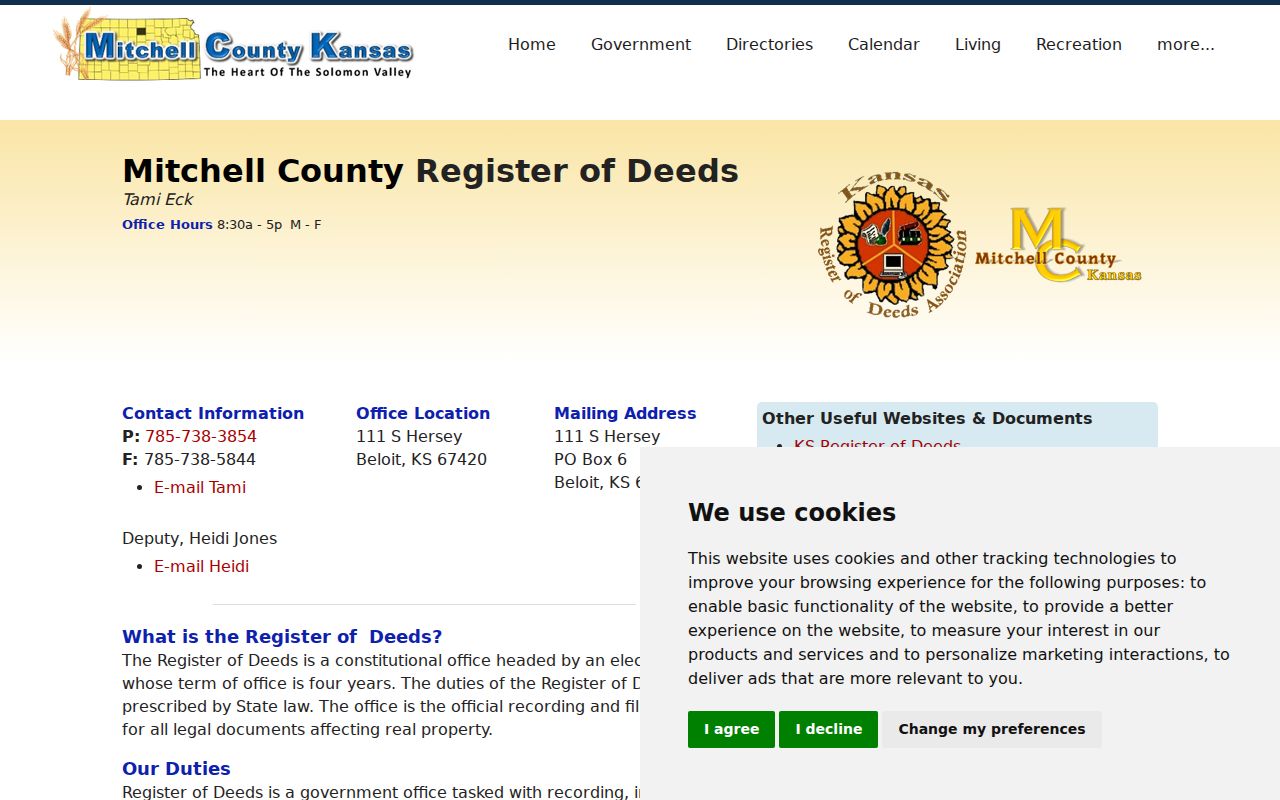
That office page shows where the deed chain continues while no public online index exists.
Port Library holds Beloit newspaper microfilm back to 1871. It also holds cemetery material, local books, and a mail or email research procedure. Its coverage is not complete. A missing notice marks a gap, not proof an event never happened.
Resolve Mitchell County Chain Gaps Carefully
Deeds, spellings, and estate language can fracture a tidy series of former owners. Corrective deeds muddy the trail. Variant spellings and changed legal descriptions do the same. Compare spouse names only when the record makes them relevant. Test repeated surnames against township and legal-description data instead of merging people. For copying a single instrument, the Mitchell County deed-search guide covers the process. Former-owner research suits house history, heir work, and purchase diligence. Information about living people must never serve to track, harass, or harm anyone.
Note: Keep a source citation for every row. That way an atlas clue never becomes an unsupported link in the deed chain.
Use Federal Land Records Before Mitchell County Deeds
The earliest private chain may predate the familiar county deed sequence. Kansas Historical Society guidance points to federal public-domain sources. It also points to tract books keyed by legal description. Those records can show a purchaser, acreage, price, and date. Later transfers then moved into county books.
Never jump from a federal purchaser to a modern parcel by surname. Township, range, section, legal description, and acreage must all align. Fix the federal entry first. Then walk forward through county deeds until that line meets your backward chain. The two directions should converge on the same land.
Track Mitchell County Corrections and Name Variants
A corrected deed fixes a spelling, legal description, or recital. It is not a new sale. Affidavits and releases may cite an earlier book and page too. Slot them into the timeline. Tag what each one does so nobody reads them as another transfer of ownership in Mitchell County.
Names trip up the search in early records. Variant spellings of one surname show up in deeds, newspapers, and atlas directories. Confirm each candidate against the land description and the date before trusting it. A spouse only belongs in the chain when the record itself makes the relationship matter. Watch for a directory abbreviating a name differently than the deed does.
Keep a Mitchell County Transfer Worksheet
Build a worksheet for every step. Log the transfer date, recording date, grantor, grantee, and deed type. Add the legal description and the book, page, or instrument number. Give each entry a source column too. The clue may have come from an atlas, a newspaper, a probate order, or a federal tract book. That way the chain shows which items actually moved an interest. It also shows which ones only filled in context.
Watch for mismatched descriptions. Two records may disagree on lot, block, section, acreage, or boundary. If they do, halt the chain until they reconcile. A shared surname and town never justify adding a former owner on their own.
Know where the county instruments stop. Mitchell County publishes no public online deed index, so no earliest deed-index year can be stated. Earlier names may take counter research, county microfilm, deed books, and state archival tools. The state atlas list and Port Library newspapers can narrow a period. Treat both as secondary clues. The newspaper run starts in 1871 but is incomplete, so silence there never disproves a transfer.
Then read the chain backward and forward. Every grantee should resurface as a grantor. Probate, a court event, survivorship, a correction, or a gap may explain why not. Keep any prior-instrument reference you find. It is often the shortest path to the next older owner of record.
Note: Keep corrected instruments on their own rows. State whether each one changed a party, a description, or a clerical detail.