
Compare Mitchell County Property Value Types
The label beside a Mitchell County number matters as much as the amount itself. Kansas applies class-specific assessment rates to appraised or economic-use value, while an actual sale price comes straight from a recorded transaction.
| Value | What It Is | Where |
|---|---|---|
| Appraised or market value | County estimate of fair market value for most real property | Appraiser and parcel roll |
| Assessed value | Class rate applied to the appropriate value base | Assessment record |
| Last sale price | Consideration connected to a past transaction | Deed and sales-validation material |
| Agricultural use value | Productivity-based economic-use value rather than ordinary market treatment | Kansas appraisal system |
Homes are assessed at 11.5 percent of appraised value. Commercial and industrial real property carries 25 percent, and vacant lots carry 12 percent. Agricultural land follows the state's economic-use approach, valued by productivity rather than by the open sale market.
The Kansas Property Valuation Division calendar sets the timing.
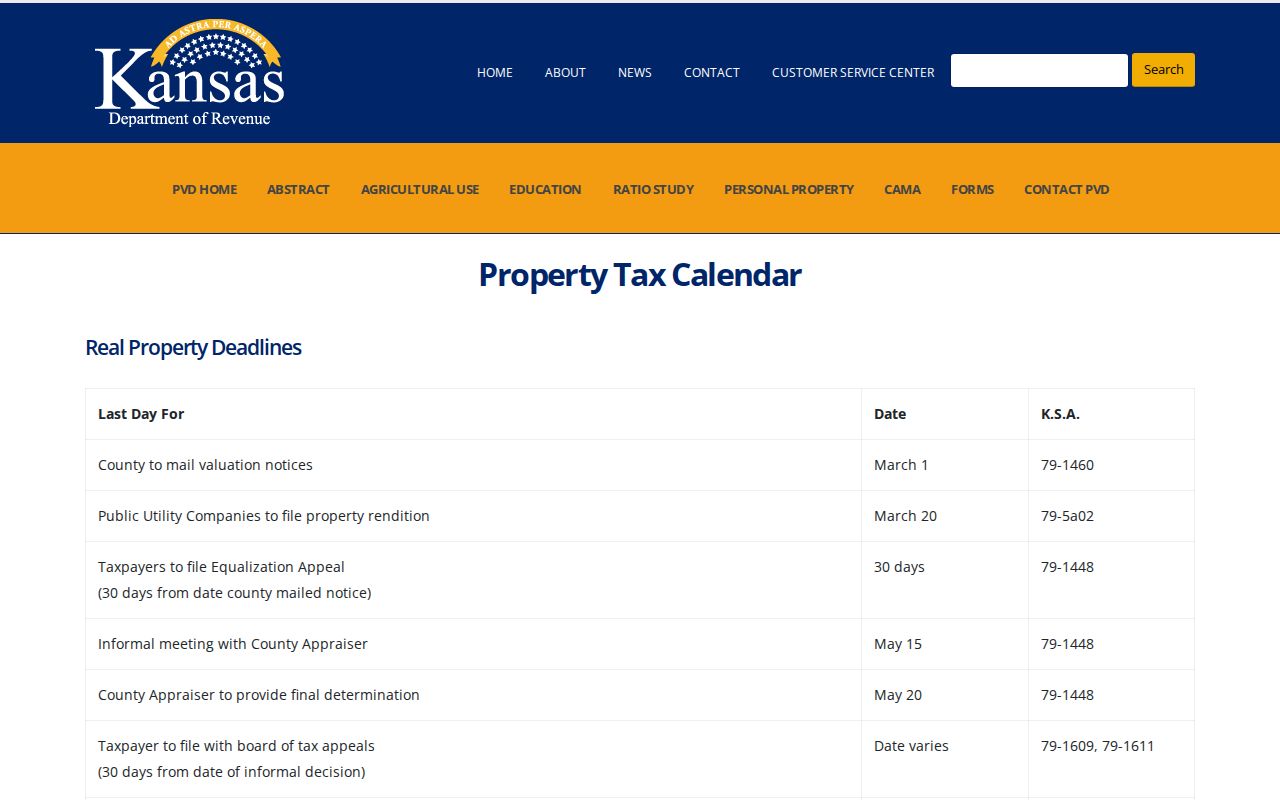
A state calendar helps you date a value record. It cannot turn an assessed amount into a current market estimate for any Mitchell County parcel.
Look Up a Mitchell County Assessed Value
Three county pages link the Parcel Search. You reach it through the Appraiser, the Clerk, and the Treasurer. Fields vary by parcel, so read only what appears and keep each value's year label tied to its tax year.
- Search the address or parcel key in the Mitchell County Parcel Search.
- Record the tax year, property class, and each displayed value label.
- Keep land, improvement, appraised, and assessed figures separate if shown.
- Use a recorded deed only for the transaction figure and its date.
- Assessed value
- The class-adjusted figure used in the tax system.
- Appraised value
- The county's estimate of market value for applicable property.
- Assessment ratio
- The statutory percentage applied to a class.
- Reassessment
- A later valuation cycle that can change the record.
Know What Mitchell County Property Value Cannot Predict
The Appraiser's number reflects a countywide appraisal. It uses a fixed valuation date and set class rules. That is its limit, too. A specific buyer may weigh condition, financing, water access, or improvements. The public roll never captures those judgments. Assessed figures that sit close together prove little on their own. A lake-adjacent tract, a city lot, a commercial parcel, and a farm are simply not comparable. Their numbers matching does not make them so.
Value versus price. Mitchell County assessed value serves taxation. It is not a sale prediction or a property-specific appraisal.
Place Mitchell County Values on the Tax Calendar
Mitchell County runs its value year on a fixed calendar. January 1 is the valuation date. Value notices go out by March 1. Informal meetings run through May 15. Values are certified by June 1. Tax bills are mailed between November 1 and 15. A property value checked later in the year still belongs to that dated cycle.
Deadlines and payment details sit with the tax side of the calendar. The Mitchell County property-tax guide lays out bills, due dates, and appeal timing. These are tied to the same value cycles.
Apply Kansas Class Rates to Mitchell County Property
Kansas classification blocks any one-rate reading. Residential real property uses 11.5 percent of appraised value. Commercial and industrial real property uses 25 percent. Vacant lots use 12 percent. Agricultural land is appraised on use value, based on productivity rather than ordinary sale-market treatment. Confirm the class before connecting appraised and assessed figures, because a mislabeled column or a cross-class comparison can fake a difference even when the county math is internally consistent.
Read the 2026 Mitchell County Market Signal
The Appraiser's 2026 market-study notice reports stable residential and commercial conditions with a general upward trend. Vacant-lot indicators were stable. Yet it is a countywide finding, not a forecast. Use it as context only. Rural acreage, flood-risk land, lake-edge property, improved city sites, and vacant lots can move differently, so any Mitchell County parcel conclusion needs actual comparable evidence and condition review.
Separate Mitchell County Sale and Recording Dates
Kansas pairs many sales with a sales-validation questionnaire. It captures buyer, seller, sale amount, property address, legal description, exemptions, and special factors. Its date reflects the signed deed or contract, not the day the Register of Deeds records the instrument. Keep both dates. A stated consideration also needs context. Family transfers, partial interests, mixed property, and exempt transactions may not behave like an open-market sale. The deed supplies evidence, not an automatic benchmark.
Note: Match the legal description before treating a recorded consideration figure as the sale history of the parcel.
Distinguish Mitchell County Value from the Tax Bill
Assessed value is one input to taxation. Levies and taxing-unit boundaries shape the rest of a Mitchell County tax bill. Equal values can produce different obligations. The Treasurer's separate Tax Search accepts last or company name, tax ID, tax year, and address parts. Its year options span 1989 through 2025. That range helps with dated tax context, but a tax amount never becomes a market-value estimate, so keep valuation meaning separate from payment status, penalties, and due dates.
Document a Mitchell County Value Finding
A good value note is easy to rebuild. Record the parcel ID, source URL, access date, tax year, class, valuation date, appraised value, assessed value, and any sale date you consulted. That keeps later comparisons reproducible when Mitchell County updates its roll or redesigns its website.
Never reverse-engineer a figure that looks inconsistent. Ask the Appraiser for the record basis instead. KORA permits focused requests for public records, subject to statutory exceptions and reasonable fees.
Compare Mitchell County Land and Improvement Value
A parcel card in Mitchell County may show value split between land and improvements. That split matters. It tells you whether a change traces to the site itself. Or it may trace to buildings on it. If the current record does not display a split, treat the total as the only solid figure. Do not assume one exists. Note the year and property class each time you save a value.
Neither figure is a market quote. Improvement value is not a replacement-cost estimate. And land value is not a guaranteed vacant-site price. Demolition, a new structure, or a parcel split or combination can shift the record between cycles. So keep the parcel number and effective year beside every comparison.
Read Agricultural Mitchell County Value by Use
Agricultural land needs its own frame in Mitchell County. Kansas values farmland by economic use, tied to productivity rather than open-market price. The figure reflects state methodology and current use. It will not line up with a simple city-lot comparison, and it should not be read as what a farm would fetch from a buyer.
Keep agricultural land separate from any home-site or improvement component on the same tract. One parcel can hold farmstead, pasture, cropland, and other uses at once. When the display is unclear, ask the Appraiser which entries apply. Cite the current parcel record itself rather than extrapolating from a neighboring tract.
Compare Mitchell County Values on Equal Terms
Line up the basics before comparing two parcels. Tax year, valuation date, class, use, and value type all need to match. An assessed residential figure and an agricultural use value are not peers. A prior sale price is not directly comparable with a later appraisal either. That holds without context on time and property condition.
A sound comparison states those limits openly. It uses actual Mitchell County fields rather than guesswork. It does not turn the 2026 general market indicator into a parcel forecast. It never assumes nearby land shares the same improvements, floodplain context, or taxing classification. Record the source date with every figure.
Mitchell County's Parcel Search does not publish a confirmed update schedule for its result fields. The screen is sometimes unavailable. In that case, request the parcel record or valuation notice from the Appraiser. Identify the tax year, class, and legal description on what you receive. Never reconstruct a missing value from a neighbor's assessment.
Sale evidence needs the same care. The Kansas sales-validation questionnaire separates the signed deed or contract date from the recording date. It also captures exemptions and special factors. A gift, correction, trust transfer, judicial transfer, or other exempt event may not reflect an open-market price at all. Keep that context beside the stated consideration. Weigh it before judging it against an appraised or assessed value.