
What Mitchell County Deed Records Document
Deeds, mortgages, releases, liens, affidavits, plats, and surveys all pass through the Mitchell County Register of Deeds. This is the official filing office for instruments that affect real property. A deed records the transfer the parties assert. The other instruments explain obligations or boundaries tied to it. Identify the instrument type first. The same names often appear in several unrelated entries. The type keeps the search honest.
| Deed Type | What It Does | Common Use |
|---|---|---|
| Warranty deed | Conveys the stated estate with deed warranties | Ordinary arm's-length conveyance |
| Quitclaim deed | Passes whatever interest the grantor holds | Family transfers or correcting an interest |
| Correction deed | Corrects an error in an earlier instrument | Name or legal-description cleanup |
| Trustee or executor deed | Conveys through a trust or estate representative | Trust and estate administration |
| Sheriff's or tax deed | Records a transfer arising from a legal process | Judicial or delinquent-tax proceedings |
A mortgage or lien is not a conveyance deed. It records a claim against the property instead. A release, filed later, shows that the recorded obligation was satisfied. Because of that, reading only deeds can leave you blind to an easement, an assignment, a judgment-related instrument, or an unreleased lien that matters to a purchase or boundary question in Mitchell County.
The Beloit Counter Is the Confirmed Search Route
Mitchell County keeps its deed records offline. The county offers no online grantor-grantee index and no image subscription. So the Register of Deeds counter in Beloit is the working route. Tami Eck holds the office at 111 S Hersey, Beloit. Call 785-738-3854, email mcrod@mitchellcountyks.gov, or write PO Box 6, Beloit, KS 67420. The counter is open 8:30 a.m. to 5:00 p.m., Monday through Friday.
Come prepared. Bring the current owner or party name. Bring a rough recording period and the parcel's legal description. Any book, page, or instrument reference you already have helps too. Ask staff which index method is available at the counter. Ask whether they can pinpoint a specific deed record. They will explain access and copies. One caution applies. The office states plainly that its staff are not trained to perform title searches.
Note: Describe the record sought narrowly; do not ask county staff to decide whether title is legally clear.
Fields to Carry Into a Deed Request
The county page lists document categories instead of a live property search form. These are the useful index targets to supply or request:
| Search detail | How it helps | Mitchell County status |
|---|---|---|
| Grantor and grantee | Finds the transferring and receiving parties | Counter procedure must be confirmed |
| Recording date range | Separates people with similar names | Ask for a bounded search |
| Legal description | Ties an entry to the correct tract or lot | Use parcel data as a bridge |
| Book/page or instrument number | Points to the exact recorded item | Exact local format not published |
| Document type | Separates deeds, liens, releases, plats, and surveys | Categories confirmed by county |
| Image or certified copy | Provides the instrument itself | Availability and fee require confirmation |
A Mitchell County property lookup can give you the address or tax identifier that starts this handoff. It still does not replace the recorded instrument. For the deed itself, the recorder's office remains the source.
See the Mitchell County Recorder Office
The captured official Register of Deeds page shows the office contact and recorded-document categories.
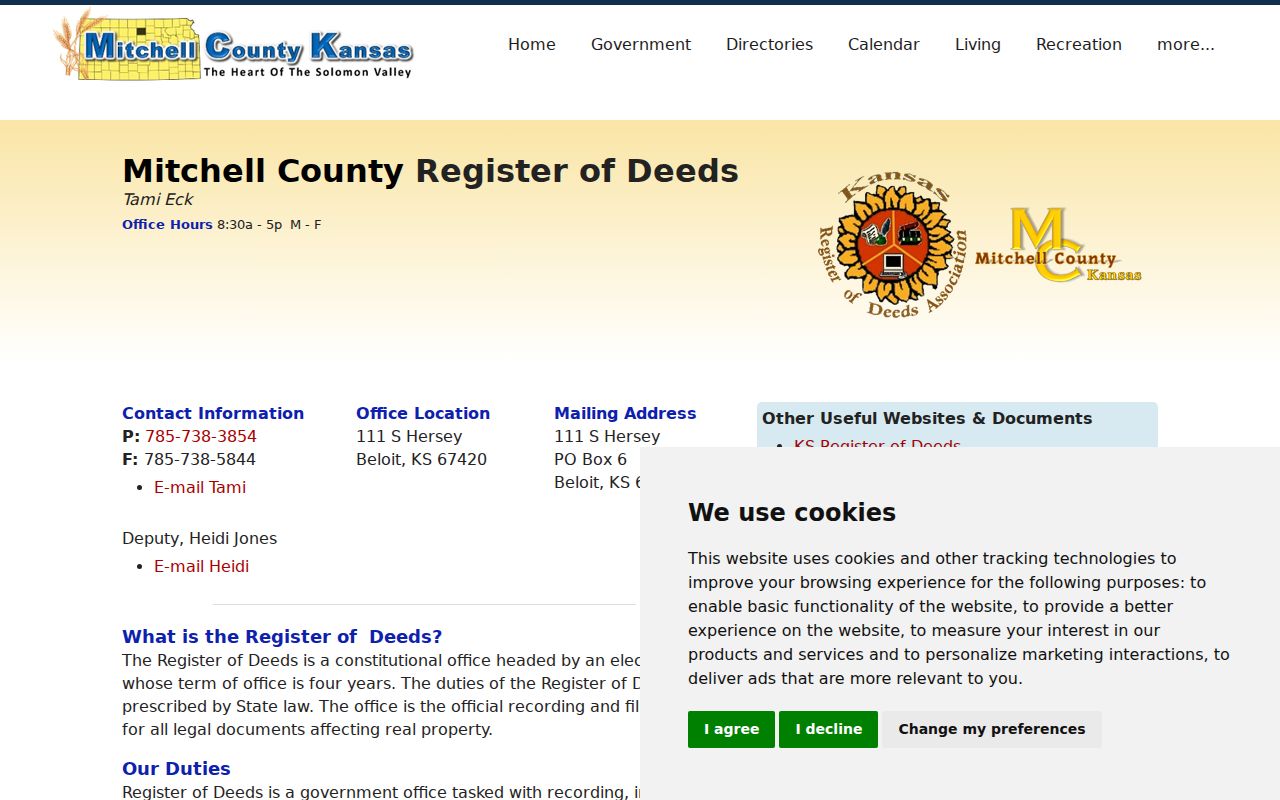
The county page serves as the doorway to the recorder's services. The office publishes no online deed index, so the deed-index search continues by mail, phone, or an in-person visit to the Register of Deeds.
Walk the Mitchell County Grantor-Grantee Chain
A backward chain traces owners through successive recorded deeds. Keep a worksheet. Log the date, names, legal description, deed type, and reference for every link. A surname match alone is never enough, because relatives and neighbors share names across decades of deed records.
- Use the current parcel name and legal description to request the newest acquisition deed, where the present owner appears as grantee.
- Read that deed's grantor, recording date, legal description, and any prior-instrument reference.
- Search the grantor as an earlier grantee, then compare the property description before accepting the link.
- Repeat backward, watching for probate, trust, court, correction, and plat instruments that interrupt a simple sale-to-sale sequence.
- Grantor
- The party transferring the stated interest.
- Grantee
- The party receiving the stated interest.
- Chain of title
- The connected sequence of conveyances affecting the same land.
- Book/page or instrument number
- A recorder reference used to retrieve a particular filing; Mitchell County's current convention should be confirmed at the office.
Month-End Recording Dates Can Shift
The Register's forms page spells out an unusual timing rule. Instruments filed after 3:30 p.m. on the last day of January through November are recorded at 8:30 a.m. This happens on the first business day of the next month. December works differently. On the last business day of that month the cutoff moves up to 10:00 a.m. Anything later records on the first business day of January. A closing date, a signed-deed date, and a recording date can all differ. The Kansas Sales Validation Questionnaire takes the same view. It counts the sale date as the day the deed or contract was signed. That is not the day the recorder stamped it. Keep both dates in your notes instead of assuming one is a mistake.
Note: A one-day recording shift at month end can move an instrument into a different reporting period.
Mitchell Deeds Before the Digital Gap
Mitchell County publishes no oldest online deed year and no imaging-conversion date. Older research therefore lives in deed and grant books. It also lives in recorder indexes, microfilm, and historical map collections. The Kansas Historical Society county microfilm guide is the state fallback for early deed records. Its land-record guidance also explains tract books. It covers legal descriptions too. Historical atlases offer snapshots rather than conveyances. Mitchell County atlases date from 1884, 1902, 1917, and 1978. They can place a surname or farm label on the map. After that, the deed chain still needs verification. County records are the authority. Beloit's original town plat was filed with the Register on March 26, 1872. The plat and its later lot-and-block deeds form a useful bridge between settlement history and recorded title. The digitized Standard Atlas of Mitchell County adds township, city, and village plats. It also includes patron and business directories. Treat those names as leads toward a parcel, never as proof of a present interest.
Sales Validation Is Evidence With a Different Date
Kansas requires a Sales Validation Questionnaire with most deeds. The form captures a lot. Seller, buyer, mailing and situs addresses, legal description, total sale price, deed date, recording reference, property use, financing, exemptions, and unusual sale conditions all appear on it. Several kinds of transfers are exempt, including certain gifts, trust transfers without consideration, divorce settlements, corrections, sheriff's deeds, rights-of-way, and judicial estate transfers.
Valuation officials use the questionnaire to interpret a transaction. A completed form does not put a public sale price on every recorded deed, though, so weigh the signed-deed date against the recorder's filing date and the assessor's tax year. Three clocks can describe one transfer.
Recorder Fees Need a Current County Check
K.S.A. 28-115 sets the fee categories. The county posts its own schedule for local charges. A statutory filing fee does not tell you what inspection, a plain copy, or a certified copy costs. Ask the Register for current copy prices first.
Submission rules matter too. Page one needs a three-inch top margin, with one-inch margins on the remaining sides. Every document must reproduce legibly, and the Register can reject an illegible filing or require a legible copy. These requirements govern recording, and they do not promise that every historic image stays equally readable.
Request a Mitchell County Deed Copy
Start with the Register of Deeds by phone, email, mail, or a visit. The office publishes no official online image system for Mitchell County deed records. Include the parties, a date range, the legal description, and any known reference. State plainly whether a plain informational copy or a certified copy is needed. Older volumes may sit at the office, on microfilm, or with a state repository. Ask which one applies.
A formal request can also be made under the Kansas Open Records Act. That law allows a written request with advance payment of copy fees. The agency must then respond as soon as reasonably possible. It can also explain any delay or denial. One instrument-specific request works far better than a blanket demand for every record tied to a name. A narrow ask gets better results.
Recorded, not guaranteed. Mitchell County deed records show instruments accepted for recording; they do not resolve every unrecorded interest or supply a title opinion.
A boundary question calls for the deed's legal description. It also calls for the plat or survey it references. Use the Mitchell County parcel map for orientation only. Litigation that could change ownership shows up elsewhere. Kansas CaseSearch and the 12th Judicial District courthouse terminal can surface foreclosure, quiet-title, partition, or probate context. Access limits apply.
A complete deed request should list the grantor and grantee spellings. It should also give an approximate recording period. Include the full legal description, and any book, page, or instrument reference found in a later document. Ask separately for plats, surveys, releases, or affidavits the deed cites. For current charges, the county's linked fee schedule is the practical source. Statutory categories under K.S.A. 28-115 do not fix every local copy cost. Confirm the amount and format before ordering a large file.
Older research can run through the Kansas Historical Society's county microfilm. The Society also offers land-record guidance and Mitchell County atlas holdings. The 1884, 1902, and 1917 atlases offer dated ownership clues. The FamilySearch catalog points toward deed and grant books and indexes. Locate names and descriptions there first. Then verify each transfer in the actual county book. An atlas label, newspaper notice, or directory entry can guide a property search. But none of them belongs in the chain of title as though it were a recorded conveyance.